




Every day we’ve been putting Unisynth up against a different groundbreaking synth plugin, and a lot of you have been asking for Unisynth and Diva to have a showdown.
So, that’s exactly what we’re doing today.
We’ll be talking about which synth plugin is the most versatile and which one gives you more flexibility overall (for all producers/sound designers).
You’ll be able to see what each synth is all about, how far each one can really go, and which one gives you the widest range inside one single plugin.
We’ll be covering everything about Unisynth vs Diva by u-he, like:
- Sound sources ✓
- Synth engines ✓
- Workflow speed ✓
- Analog character ✓
- Hybrid power ✓
- AI generation ✓
- Modulation depth ✓
- Routing options ✓
- FX section ✓
- Real flexibility ✓
- Overall versatility ✓
- So much more ✓
After the head-to-head, you’ll be able to see which synth gives you more creative freedom and which one can cover more ground (big picture wise).
Plus, you’ll see which one is better for modern producers, deeper sound design, and faster idea generation when inspiration strikes, which can happen in a flash.
Overall, it’ll all boil down to versatility and flexibility.
And by the end, the winner will be crowned the most versatile, flexible synth plugin in the entire world, so let’s get to it…
Table of Contents
Unisynth: The #1 AI Synth Plugin in the World
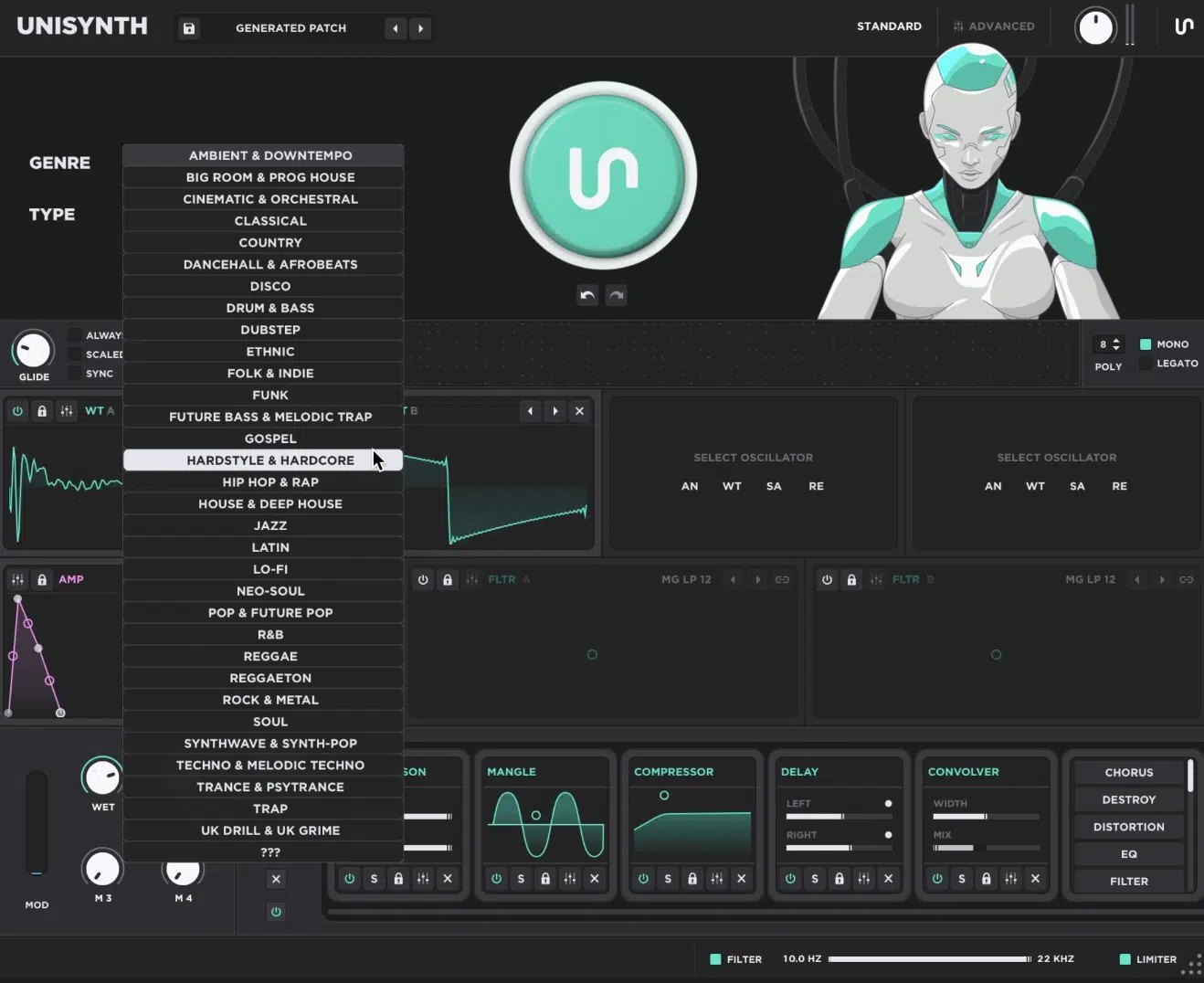
Let’s kick things off with breaking down what Unisynth is all about, because it’s much more than just a big fancy spec list, trust me.
It’s the world’s first (and only) AI genre-specific, generative plugin in the game, built around 32 genres and 6 sound types.
You choose the genre and style/kind of part you want and boom: killer sounds without having to stare at a blank patch or endlessly scroll through presets.
Then, once you get past that first layer, you’ll find that it’s a full-fledged hybrid synth with 4 oscillators, and each oscillator can switch between:
- Analog (classic synth waveforms)
- Wavetable (moving through different waveform frames)
- Sampler (audio playback as a sound source)
- Resonator (a model that creates tone by exciting another source)
So right off rip, it already covers a lot more territory than a synth that mostly lives in one sound family, just saying.
On top of that, it gives you 2 primary filters with 95 filter types each, a built-in wavetable editor and flexible routing.
Plus a modulation system that can run up to 48 simultaneous modulators, which is epic, and a two-view layout…
Standard View keeps things quick, visual, and easy to push around, and Advanced View opens the door to more detailed editing, deeper modulation, etc.
Even the effects section is bigger than you’d expect, with 25 built-in FX, so you can generate a sound, shape it, and push it to the limit (and beyond).
Bottom line, Unisynth feels less like a synth with one main specialty and more like a mind-blowing sound design playground for all genres, vibes, and styles.
Diva by u-he: Breaking it Down
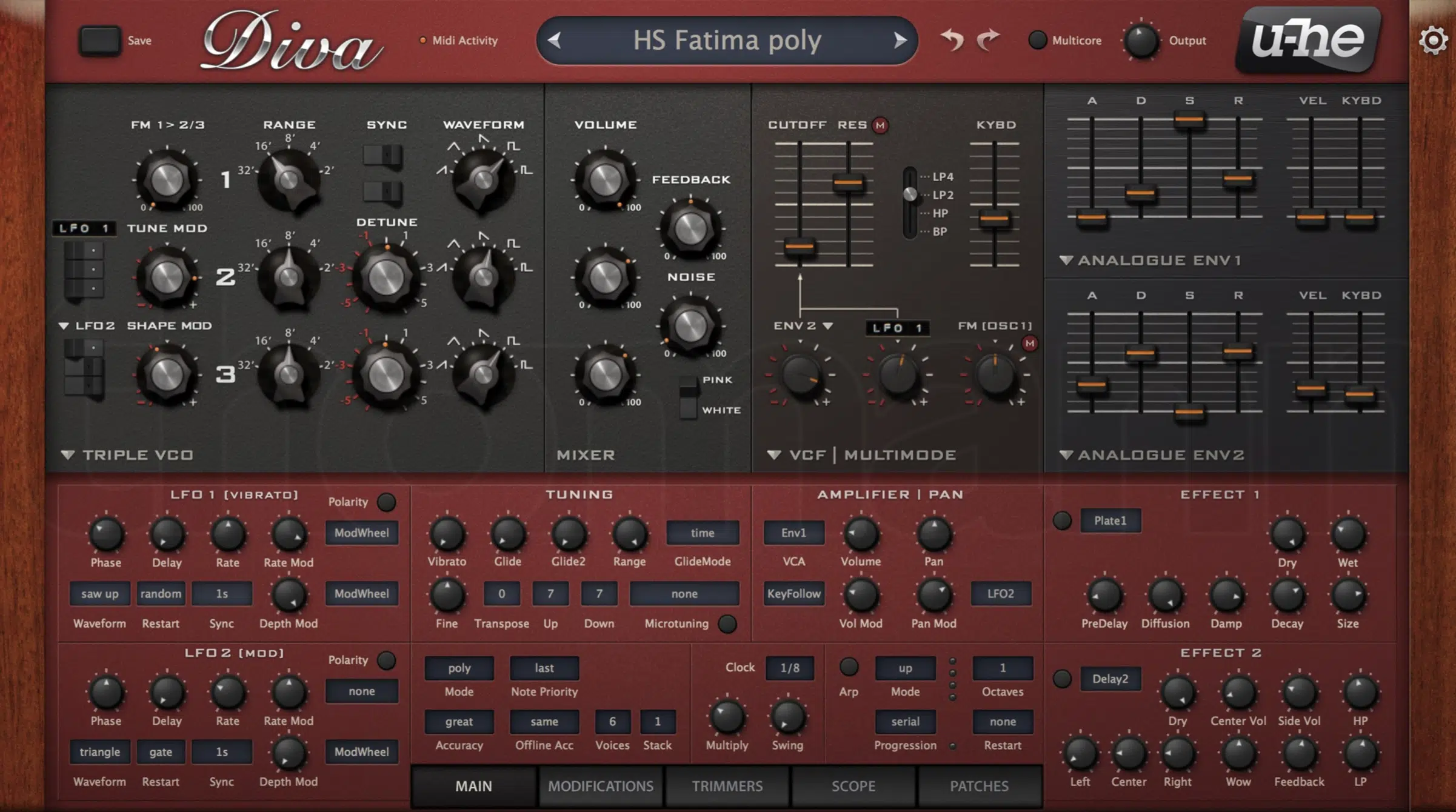
When talking about Unisynth vs Diva, it’s obvious that Diva by u-he is a very targeted synth: analog modeling.
It’s only about vintage-style tone, classic synth behavior, and that timeless, hardware-inspired character.
You get 5 oscillator models, 5 filter models, 2 host-syncable LFOs, 2 stereo FX slots, an arpeggiator, and more than 1,200 factory presets.
Mix-and-match classic modules, zero-delay-feedback filter design, and detailed circuit-style modeling being front and center.
Basically, you go to Diva when you want that classy analog vibe, not when you want AI generation, sample-based layers, resonator engines, or a giant sound-design sandbox.
But, is it more versatile than Unisynth? 一 Well, we’ll soon find out.
Unisynth vs Diva: Which is More Versatile?
Now that you know a little bit about what each synth is all about, let’s get to the interesting Unisynth vs Diva debate: key features, functions, and overall versatility. It’s more about which one can stretch further, switch roles more easily, and give you more ways to build sounds without cornering you into one main style of synthesis. So from here, we’re going to break the whole thing down piece by piece — and once you do that, the versatility winner will soon be super clear.
Sound Sources and Synthesis Range
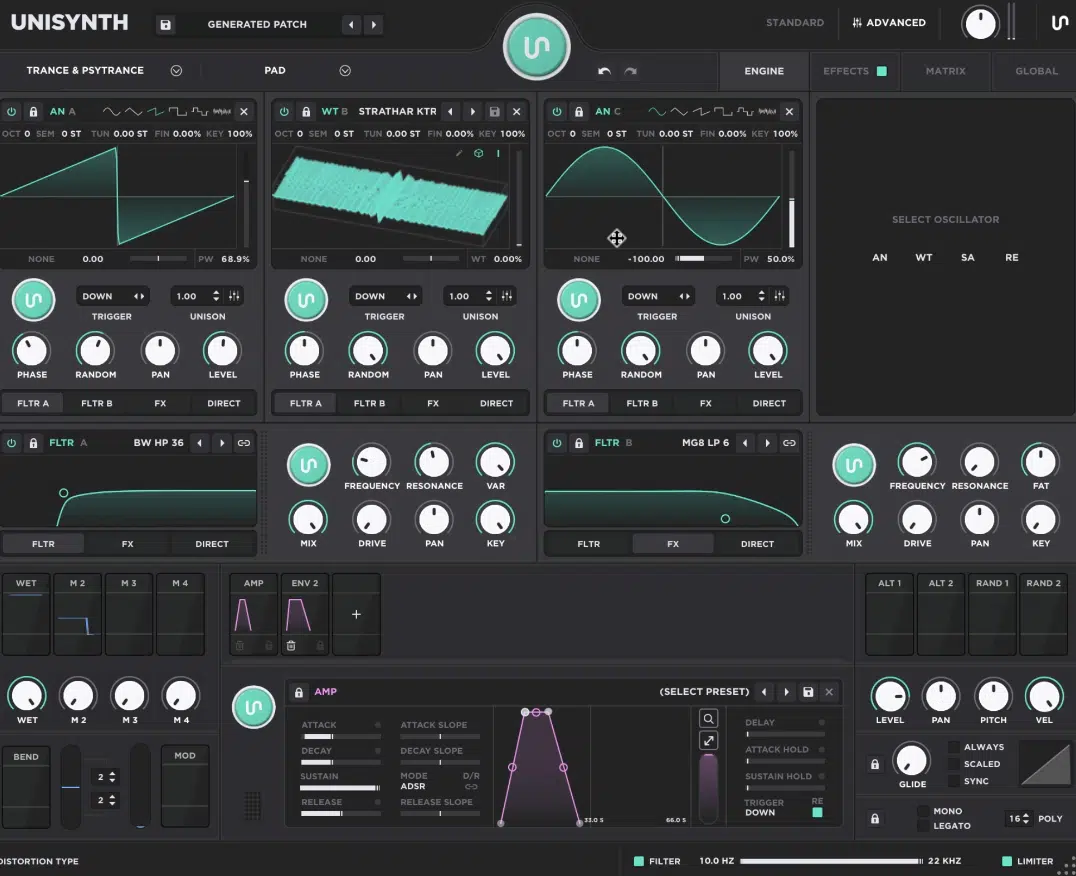
First up on the Unisynth vs Diva debate, let’s talk about sound sources and synthesis range — what are you actually starting with before filters, FX, and polish?
Unisynth comes in hot here, because it gives you 4 fully independent oscillators, and each one can be switched between 4 engine types like we just talked about.
Analog (classic synth waveforms), Wavetable (multiple waveform frames you can scan through), Sampler (audio playback as the source), and Resonator (a physical-modeling-style engine that gets excited by another oscillator).
So, right away, one patch can blend subtractive warmth, moving digital harmonics, sampled texture, and more resonant, body-like tone all at the same time.
Right away, this is crazy unique and ventures outside of what most classic analog-style synths are even trying to do.
The Sampler side lets you pull from included material or load your own audio, which means this epic synth is not boxed into a fixed set of oscillator personalities from the jump.
The Resonator then gives you another whole lane, since it uses another oscillator as the exciter and creates more physically inspired tones, if you know what I’m saying.
Ones that feel ringy, resonant, and a lot less typical than standard subtractive stuff.
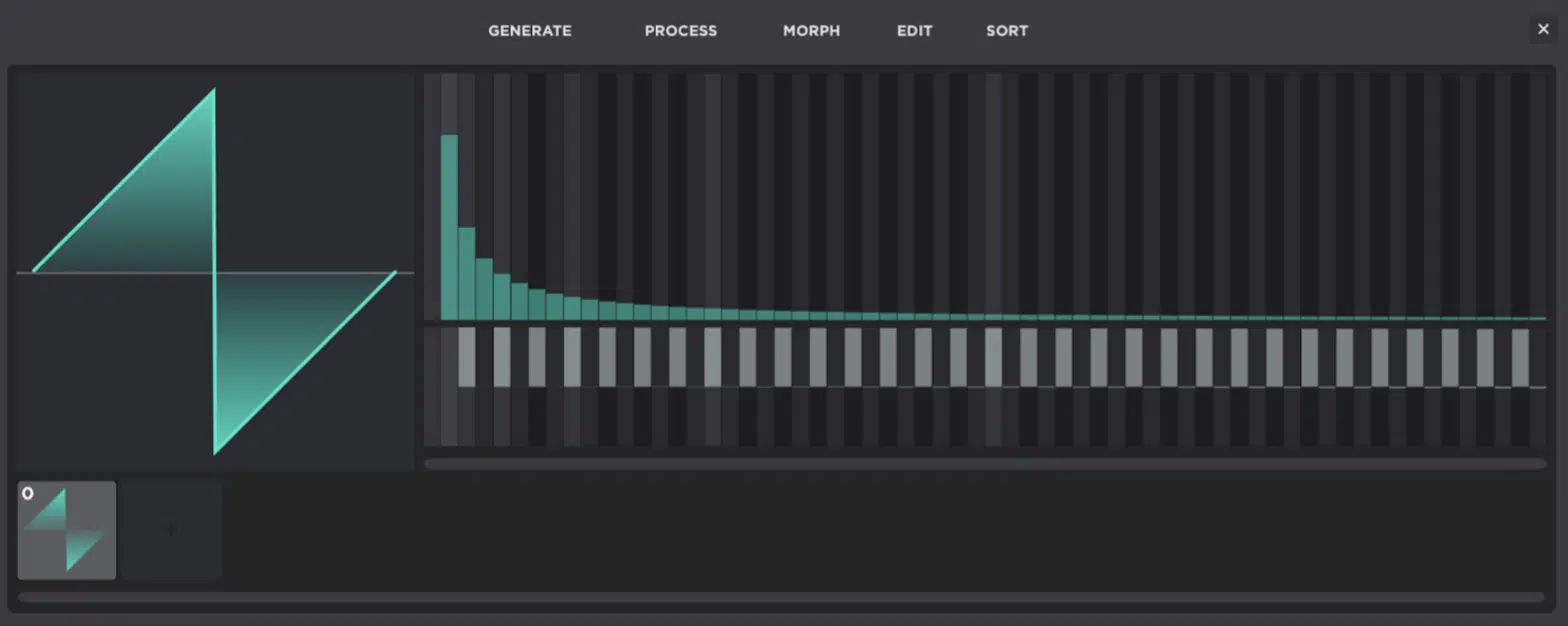
Unisynth’s Analog oscillator goes even further than the name suggests, because it includes special warp and distortion modes that can really help you bring things to the next level, like:
- FM
- PM
- RM
- AM
- Sync
- Bend
- PWM
- Flip
- Mirror
And when it comes to the average analog oscillator that just gives you a few basic waveforms and calls it a day, this is legendary.
It can spit out timbres and harmonic shapes that go WAY past what you’d usually expect from an analog-style front end.
That pushes it into territory Diva simply does not cover the same way.
Diva, to be fair, still gives you a very respectable foundation with 5 oscillator models and 5 filter models based on classic hardware.
That mix-and-match setup is a huge part of why it sounds so convincing in the vintage realm, nobody’s denying that…
But that’s really the point in this Unisynth vs Diva debate: Diva has the deeper analog identity, while Unisynth gives you the bigger tonal foundation by a mile.
So, if the category is pure range, Unisynth just has way more raw material to play with.
Workflow and Speed
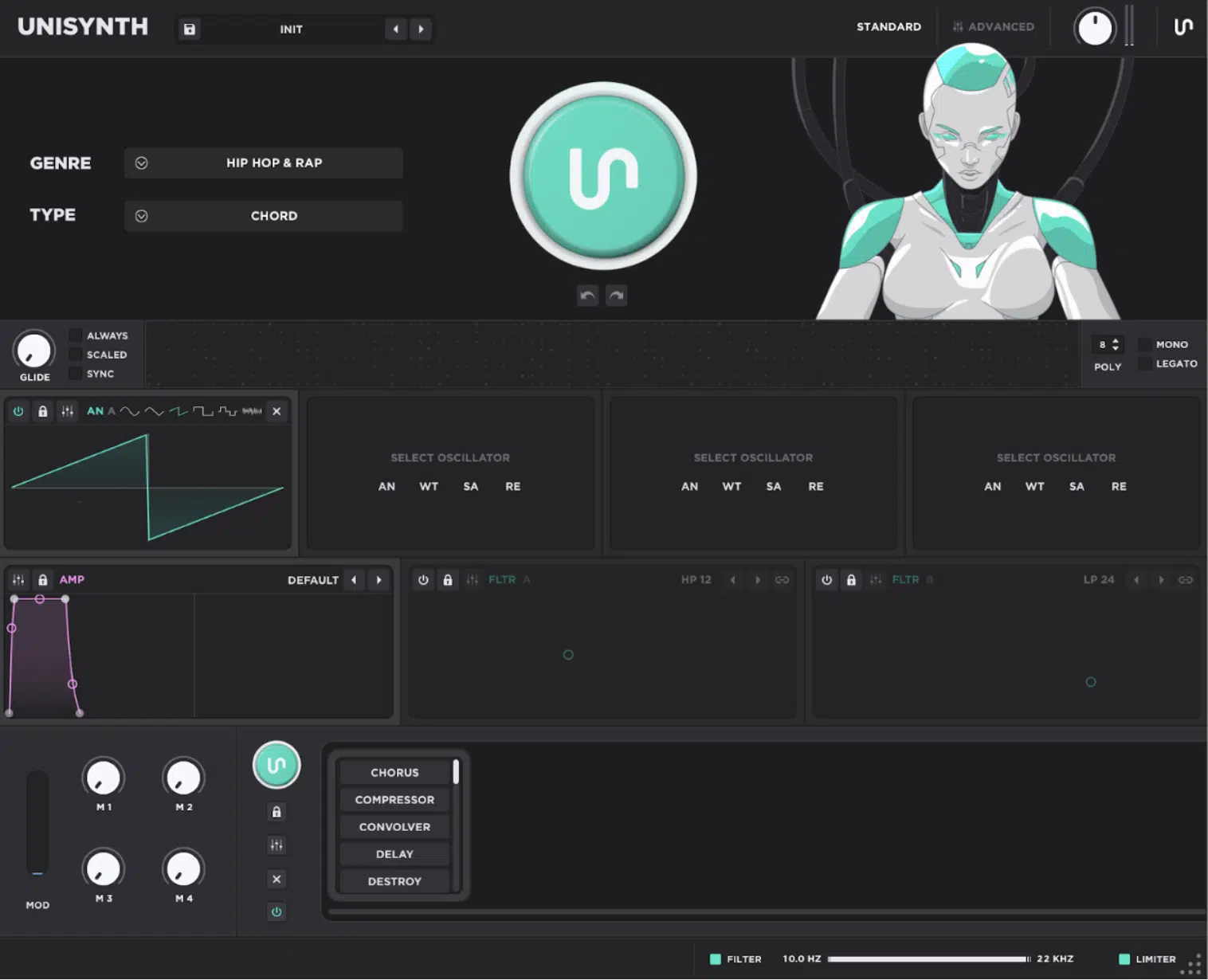
When it comes to Unisynth vs Diva, workflow is all about how fast each synth can get you from “I need a sound” to “okay, this is fire.”
That part can either keep the session moving or kill the vibe completely.
Unisynth is built to keep things rolling, since the front end is dead simple with 3 simple steps:
- Choose 1 of 32 genres
- Pick 1 of 6 sound types
- Hit the Patch Generator
Then, you instantly get a new patch to mess with instead of spending the next 20 minutes building one from scratch (and you can do this infinite times!).
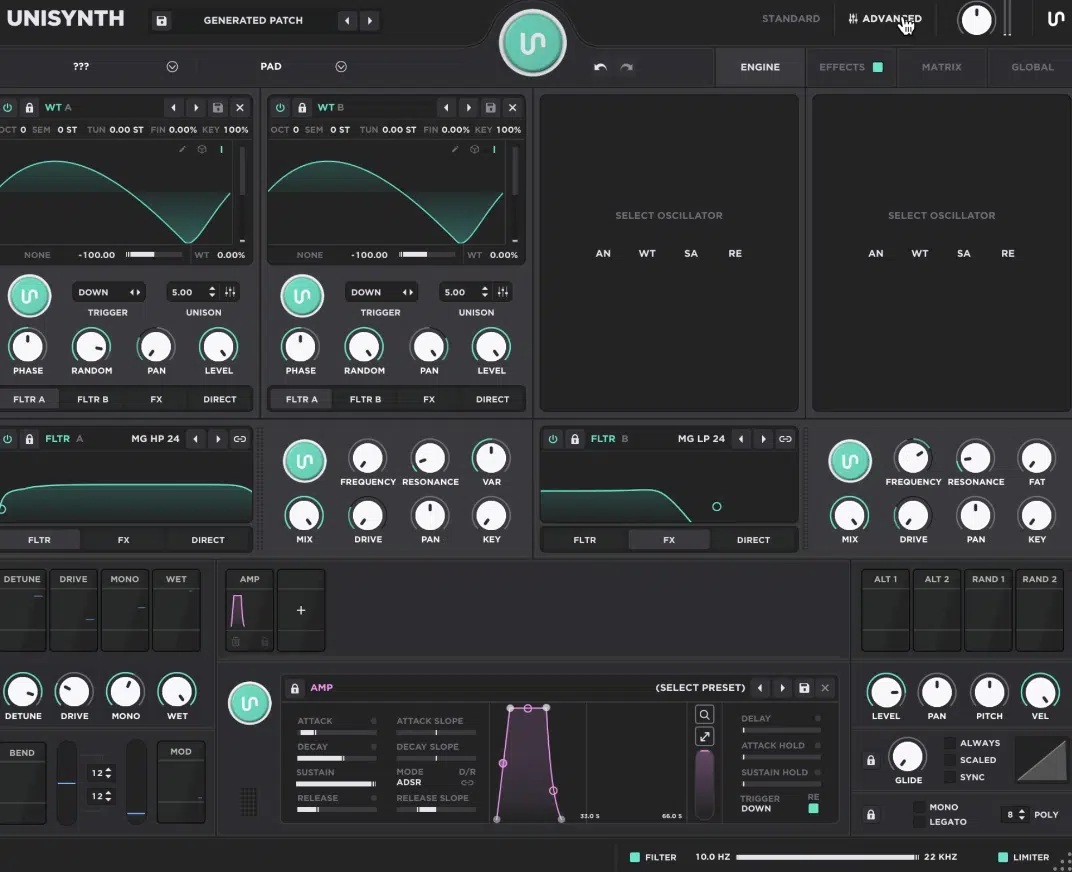
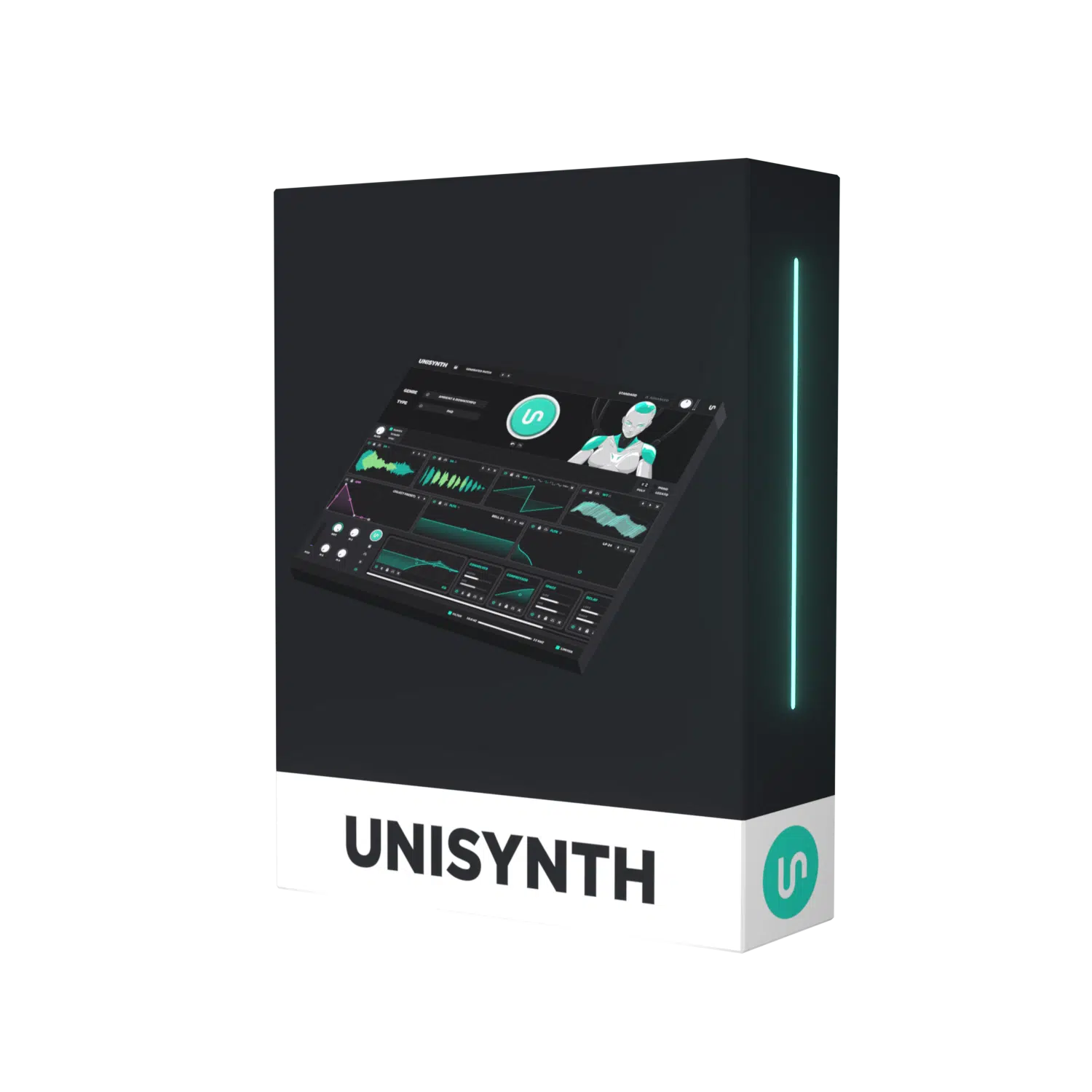
From there, you can stay in Standard View, which you can see pictured above, if you just want to move fast and shape the sound visually real quick.
Or, you can play around inside of the Advanced View when you want to go deeper and start dialing things in more precisely 一 razor-sharp precision, to be exact.
And then you’ve got the FX-Chain Generator, which can spit out different chains based on the selected genre and type.
This means the speed advantage doesn’t stop at the oscillator level — it carries into the finishing side too.
NOTE: This means you can move from idea to variation to another variation ridiculously fast, and that’s exactly how you end up finding sounds you probably wouldn’t have bothered (or been able) to build manually.
Diva, on the flip side, takes a much more traditional route…
Choose the oscillator module, choose the filter module, shape the envelopes, and dial in the modulation.
Then, either build the patch yourself or start from one of the 1,200+ factory presets and tweak from there.
Now obviously there’s nothing wrong with that because, for classic analog patch building, it’s super satisfying.
However, it’s a much slower, more deliberate process that expects you to stay inside Diva’s hardware-inspired world.
And that, my friends, is where the gap really opens up, because there are very few sounds Unisynth cannot at least move toward convincingly with its hybrid engine.
While Diva on the other hand is pretty much always going to keep you in the classic analog synth realm (yes, even if it does that realm beautifully).
So if we’re talking speed + flexibility together, not just careful craftsmanship in one style, Unisynth is undeniably the more versatile option, no ifs, ands, or buts.
Modulation, Routing, and Sound-Shaping Depth
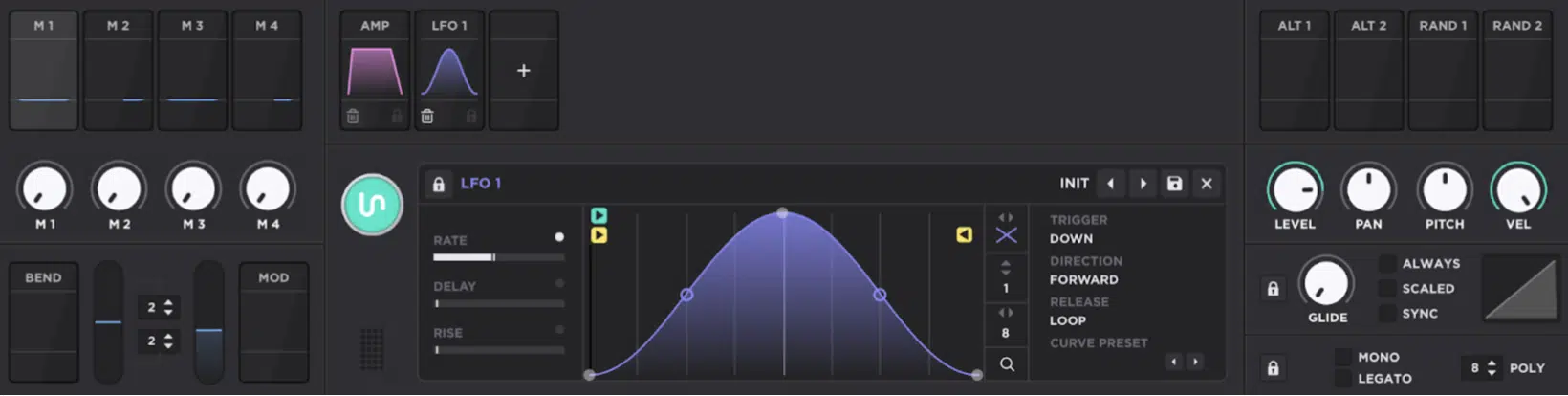
Modulation and routing are where you find out whether a synth is just giving you a handful of nice sounds or can actually let you build deeper internal movement.
Unisynth gets crazy deep here, because it supports up to 48 simultaneous modulators, and those include:
- Envelopes
- Chaos modulators
- Drawable LFOs
- Trackers
- Macros
- Bend
- Mod wheel
- Alternate triggers
- Random sources
On top of that, the whole thing is set up around drag-and-drop modulation, floating depth controls, aux modulation, and a full modulation matrix.
So, needless to say, assigning motion is not some afterthought side feature — it’s baked right into the way the synth wants you to work.
The routing side is just as flexible too, since each oscillator can be sent to Filter A, Filter B, FX, or Direct.
And, better yet, both filters can also be arranged in very different ways depending on how you want the signal to move through the patch (very intriguing ways).
That means you’re not just modulating knobs, but actually shaping the whole architecture of the sound, which is where things start getting really fun and honestly kind of nuts.
Diva absolutely has useful modulation tools, like 2 host-syncable LFOs, per-voice oscillator detune, user-definable modulation source behavior, and a few extra tricks in the Modifications panel.
Still, it’s much more pre-defined and panel-based in the way it handles modulation and it doesn’t give you the same big, open-ended, drag-and-drop matrix workflow.
So, while Diva gives you enough movement for classic synth work, Unisynth gives you more control over how motion, routing, and behavior all interact across the patch.
And once you start building more layered, evolving, or straight-up weird sounds, that extra depth stops being a bonus and starts feeling like the whole game is being changed.
In this Unisynth vs Diva section, I have to give it to Unisynth once again, so Diva is definitely in trouble here.
Effects, Finishing Power, and All-in-One Capability
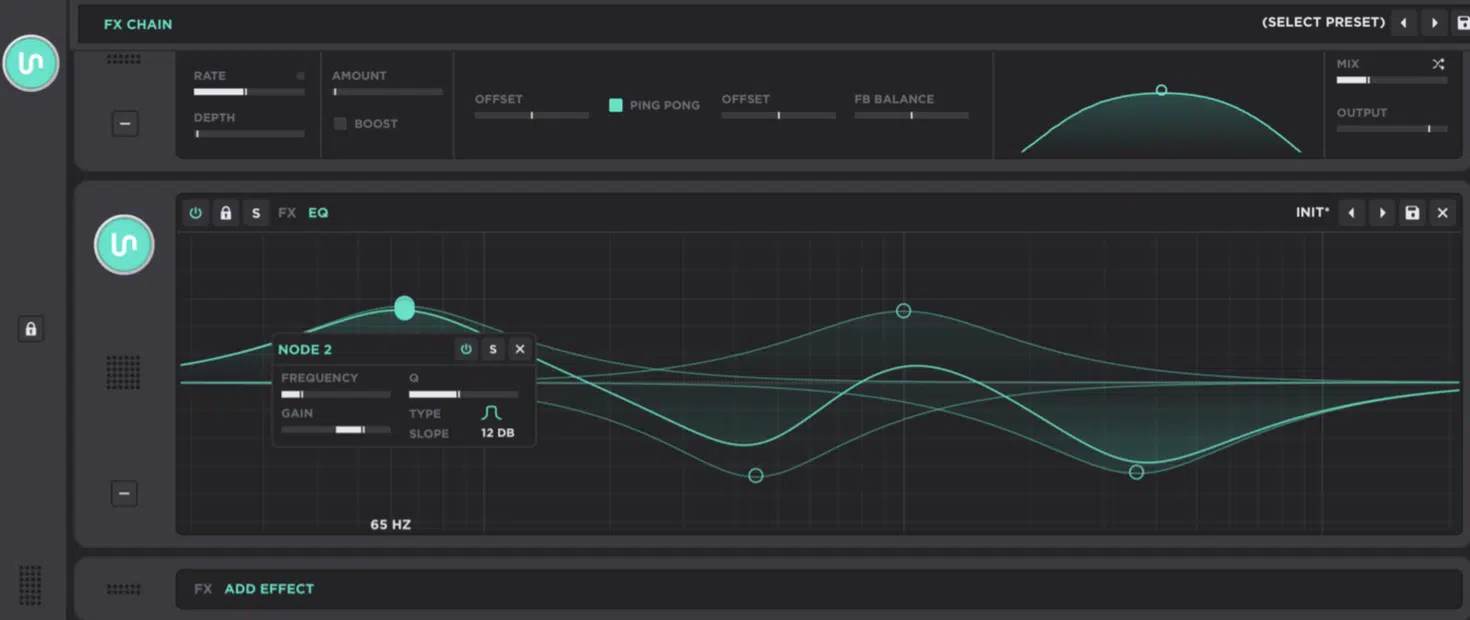
In the Unisynth vs Diva showdown, it can’t be judged until we talk about, the effects section.
It’s all about how far each synth can take a sound before you even need to leave the plugin environment (because that can save a crazy amount of time once you’re deep into a session).
Unisynth is stacked here with 25 FX, including:
- Delay & reverse delay
- Multiple distortion styles
- Compressor
- OTT
- EQ
- Filter
- Chorus, flanger, phaser
- Super Unison
- Tremolo & vibrato
- Convolution reverb & algorithmic reverb
- Panner, utility, width
- Etc.
Better yet, those effects can be generated, reordered, collapsed, edited in detail, saved as chains, and in many cases modulated.
This is part of the reason Unisynth feels so complete…
You can generate the patch, shape the engine, build motion, and then start finishing the sound right there without instantly stacking five more plugins in your unique DAW.
Diva keeps it much tighter and much more old-school, with 2 stereo effects slots that can load things like chorus, phaser, plate reverb, delay, and rotary speaker.
Those effects fit Diva’s vintage vibe nicely, and they do the job for polish, width, and movement inside that analog-style world.
Still, it’s not even close to the same kind of finishing environment as Unisynth because Diva’s FX section is basically there to complement the synth.
Unisynth’s FX environment, on the other hand, can become a major part of the sound design process itself, which really kicks things up a notch in a major way.
So if the question is which one gives you more all-in-one power before you have to reach for outside help 一 Unisynth takes that round pretty easily.
Bonus: AI (Artificial Intelligence) For Ultimate Flexibility
With Unisynth vs Diva, the AI factor is all about whether they can actively help you discover sick sounds faster or just sit there waiting for you to program everything manually.
This is one of Unisynth’s biggest advantages because its whole front-end is built around generating fresh, genre-aware patches on demand.
Like we said, no more digging endlessly through preset folders, hoping and praying.
You can generate unlimited unique sounds across 32 genres, with undo/redo capabilities, macro moves, and the FX generator until it’s absolutely perfect.
That changes the whole creative flow, because you’re no longer stuck choosing between “build from scratch” and “scroll through presets forever.”
Instead, you can hear way more options per minute, switch directions faster, and chase ideas while they’re still hot and fresh in your mind (peace out beat-block).
It also opens up a much bigger pool of possible sounds, since the AI layer is feeding a hybrid engine with analog, wavetable, sampler, and resonator modes behind it.
The range you can pull from is out of this world, no joke.
And it’s not that Diva is bad or anything like that, it just can’t touch Unisynth because it wasn’t designed to generate/brand out in this way.
Diva gives you a strong traditional workflow, great tone, and a lot of preset value, but it just doesn’t offer any equivalent AI layer for instant sound discovery, guided variation, or fast idea expansion.
So no, the AI side is not just marketing fluff here…
It’s one of the biggest reasons Unisynth feels more flexible in an actual production session, which is what this whole competition is all about.
Unisynth vs Diva Final Thoughts: Which One Gives You More Overall Versatility?
At the end of the day, Unisynth vs Diva is not really a debate about whether Diva is a serious synth, because it absolutely is…
And in the software world, it’s still one of the best when it comes to modeled analog tone, vintage character, and that expensive hardware-style feel, period.
But once the standard shifts to versatility, the crown has to go to Unisynth.
It covers more synthesis types, workflow styles, routing options, modulation depth, internal finishing power, and way more sonic territory inside one instrument.
Then, once you add the AI-driven generation side to the mix, it becomes even harder to ignore how much more flexible it is for modern producers.
Especially if you’re all about speed, range, flexibility, and depth in the same plugin (which, let’s be honest, we all are).
Diva still wins its own lane, but it’s a more focused vibe built around one specific mission.
Unisynth, on the other hand, covers more ground, adapts to more situations, and gives you way more opportunities to create mind-blowing sounds.
So, the ultimate winner in the versatility wars is: Unisynth!
Until next time…
Try Out The Most Versatile Synth in the Game



Leave a Reply
You must belogged in to post a comment.